
Non QM securitization broke records in 3Q: Morningstar
New private-label bonds collateralized by loans made outside the qualified mortgage definition hit highs for the month, quarter and year, CreditFlow data shows.
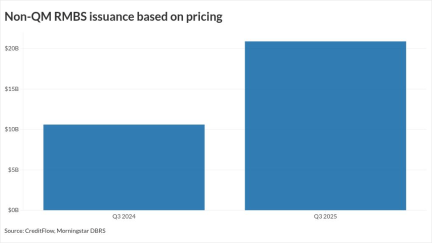
New private-label bonds collateralized by loans made outside the qualified mortgage definition hit highs for the month, quarter and year, CreditFlow data shows.
On a weighted average (WA) basis, the collateral mortgages have a slightly higher leverage level than previous transactions, although moderate, with an original loan-to-value (LTV) ratio of 71.9%.

A large majority of the pool assets, 86.2%, are second-lien home equity investment contracts that have a weighted average (WA) multiple share rate of 2.00x.

The Structured Finance Association is adding its weight to recent support for a Securities and Exchange Commission action that could modernize Reg AB II.

SEMT 2025-12's collateral profile is slightly weaker compared with the prior transaction, with a slightly lower weighted average FICO score.

Second-lien mortgages make up the collateral pool. Those assets normally have a high expected loss severity, but the borrowers appear to be of prime credit quality.

Most of the pool of 1,011 residential mortgages, 69.7%, are considered non-prime mortgages, primarily due to the documentation and styles of underwriting.

The pool appears to be well diversified by loan originator. Vista Point Mortgage and FundLoans Capital together originated the largest portion of the portfolio, representing 29.3%.

The A1 tranche contains the bulk of the outstanding notes, $251.4 million, and is divided into the 1A and 1B sub-tranches, with enhancement of 37.0% on the A1A piece and 27.0% on the A1B.

If the average one-month conditional prepayment rate (CPR) over a six-month period is equal to or greater than 25%, then Brean ABS will deposit 50% of available funds into the Refunding Account.

Karsten Giesecke and Michael Karol join Morriello to represent clients such as lenders and private equity funds in transactions including RMBS, CMBS, franchise loans and esoteric assets.
The deal involves a two-year revolving period, and during that time principal proceeds can be reinvested into newly originated collateral.

Rithm Capital, a real estate investment trust, is sponsoring the deal, in which property focused investor loans represent 32.60% of the collateral pool.

Almost all the mortgages were written through alternative income documentation, primarily for investment properties, and the entire pool benefits from third-party due diligence.

Among other credit boosting measures, the structure also prohibits any interest from being advanced on loans that are more than 90 days delinquent.

Some 63.8% of the assets in the pool are modified loans, and for 92.6% of those loans, the modifications happened more than two years ago.

The A1A notes benefit from credit enhancement levels that equal 30% of the note balance in that tranche.

The subordinate classes will always pay principal sequentially, but their repayments start after all the senior classes have been retired.

About 73.9% of the underlying mortgages were underwritten through debt service coverage ratio (DSCR) and 12- to 23 months of profit and loss and bank statements.

The deal will issue class A through class G certificates through a structure of eight tranches, which includes a payment-in-kind feature for the class E, F1, F2 and G certificates.

Couldn’t load more articles. Try again.