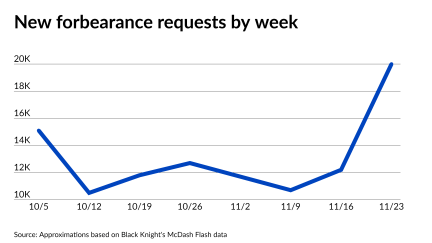
The rate at which borrowers suspended payments on their home loans rose for a second week in a row between Nov. 16 and 22, climbing 6 basis points to 5.54%, according to the Mortgage Bankers Association.
Even government-sponsored enterprise loans, which have seen forbearance rates drop for 24 weeks in a row, saw a slight uptick to 3.36% from 3.35% the previous week.
Also, the Ginnie Mae forbearance rate rose 10 basis points to 7.83%, and the forbearance rate for loans in portfolios and private-label securities climbed 15 basis points to 8.63% from 8.48%.
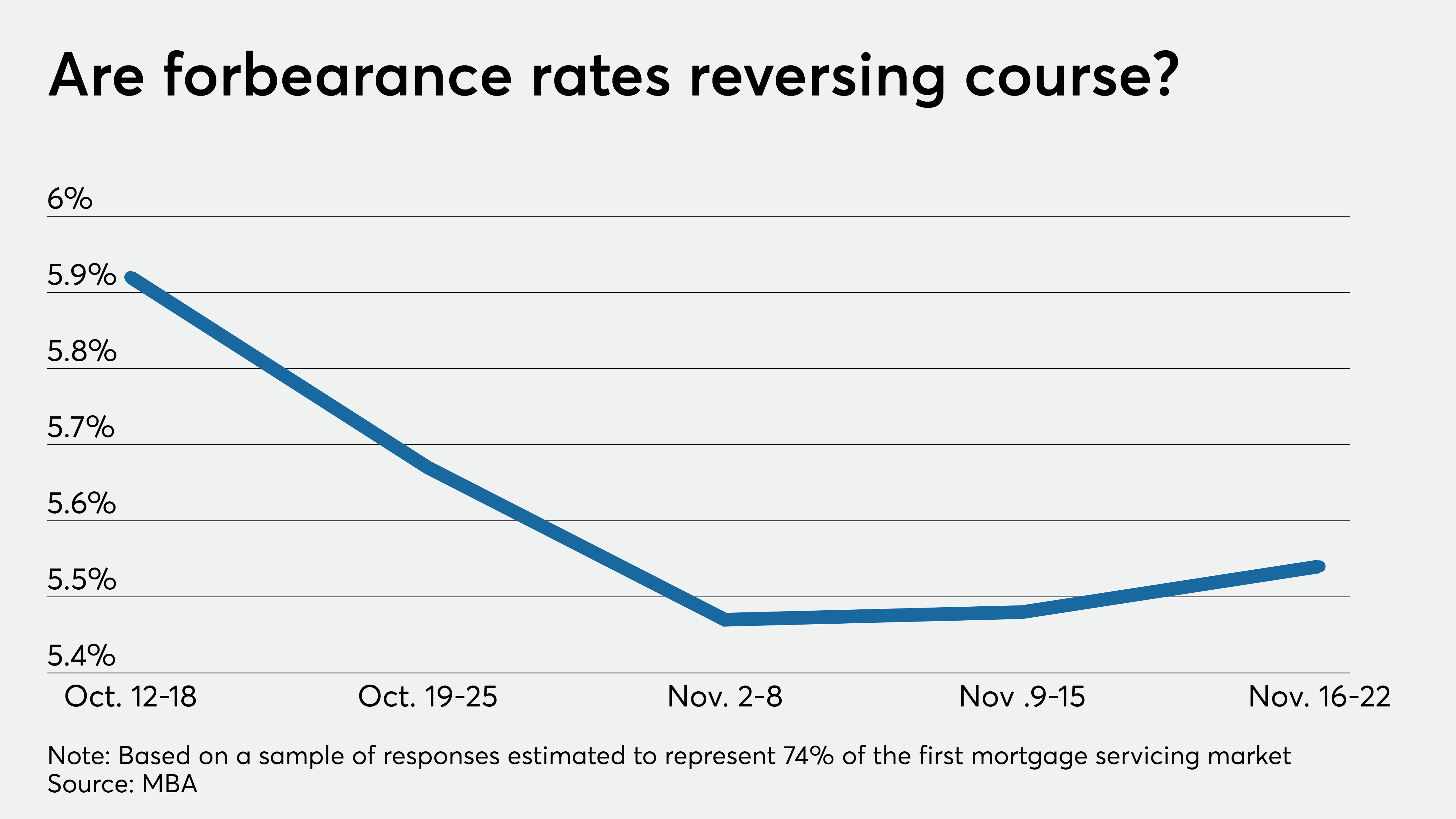
The uptick could in part be a positive reflection of outreach campaigns designed to spread awareness of the temporary payment relief available, but other indicators suggest that there is new distress in the market as well, according to MBA Chief Economist Mike Fratantoni.
“There was an increase in forbearance re-entries, as borrowers who had previously exited sought relief again,” he said in a press release. Fratantoni also noted that exits from forbearance have slowed to a survey-record low.
During the most recent week, 20.3% of loans in forbearance are in the initial plan stage, 77.42% were extended and the remaining 2.24% represented re-entries.
A strong housing market fueled by tight supply relative to demand, low mortgage rates and other temporary government measures have helped offset the impact of suspended payments, but there is some concern that expiring public programs and seasonal slowing could weaken market conditions.
“Recent housing market data remain quite strong and we expect the market is positioned for additional growth next year, but these data show that additional support is likely needed through the winter,” Fratantoni said.
His comments dovetailed with those of experts speaking on a housing panel at the Information Management Network’s ABS East virtual event on Tuesday, who also predicted expiring government programs could take some wind out of the residential real estate market’s sails.
“We’ve had a lot of things happen like cheaper financing, forestalling of any eviction and foreclosures due to the government regulations or initiatives. That’s helped get us through, so remember that, most likely, we can’t keep going at the same accelerated pace,” Mark Fontanilla, a consultant at DBRS Morningstar, told attendees at the IMN event.