Starwood Capital’s debut RMBS is mix of nonprime, near-prime
Unusually, all of the loans in the $374 million transaction were purchased from a single originator, Impac Mortgage.

© 2026 Arizent. All rights reserved.

Unusually, all of the loans in the $374 million transaction were purchased from a single originator, Impac Mortgage.
The company spun out of DriveTime is paying for the privilege, however; it's offering 50.3% credit enhancement on the senior notes of the $338 million deal rated by Kroll.

The company controlled by Emerald Development Managers has already ceased originating; S&P has notes from a 2016 securitization on watch and Kroll is monitoring the situation.

Seven years after James Gutierrez left Oportun Financial and started a competitor, the acrimony sparked by the divorce is coming into public view.
While S&P expects higher net losses to over a five-year span, Kroll believes stricter reinvestment criteria for the extended revolving period can reduce them.

The $1 billion DRIVE 2019-2 is backed by loans with slightly weaker credit metrics than the lender's prior deal, forcing it to increase credit enhancement.

From financing driverless cars to dealing with Libor's demise, here are the highlights from the Structured Finance Industry Group's annual conference.

Allowing borrowers to defer payments can be an effective way to mitigate losses, but only when used judiciously, according to S&P.

CIG is marketing $161.9 million in bonds backed by auto loans made through independent dealers, while RAC is placing a $174.5 million securitization of used-car leases.

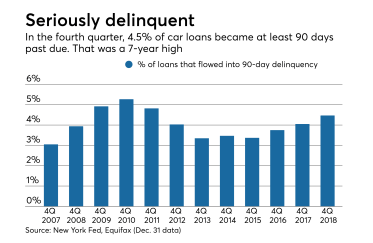
New research from the New York Fed found that banks with more than $50 billion of assets originate more subprime car loans than small banks and credit unions do.
Chrysler vehicles dominate Santander's latest pool, reflecting increased originations that CEO Scott Powell believes will maintain the lender's captive-finance status.

Executives from Ally Financial and Santander Consumer USA gave rosy outlooks about 2019 consumer trends, while other banks that rely less heavily on car lending offered more cautious appraisals.
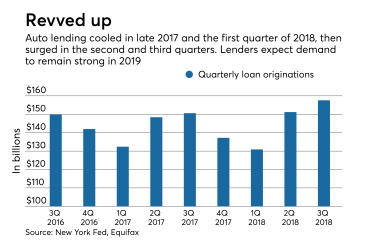
Both lenders are boosting originations to borrowers with near-prime loans, though the impact on the overall credit quality of the collateral for their deals is slight.

The collateral for the $550 million transaction is slightly weaker than that of its prior deal, but rating agencies expect cumulative net losses to be in the same range.
More than 45% of collateral for the $254.4 million CPSART 2019-A are either "preferred," "super alpha” or “alpha plus”; that's up from 42.4% of collateral for the prior deal.

The latest deal from the sponsor's DRIVE platform for deep subprime loans benefits from recent improvements in underwriting; both S&P and Moody's have lowered loss expectations.

It’s a trend that bears watching, particularly for holders of the riskiest securities issued in subprime auto securitizations, according to S&P Global Ratings.

The $175 million deal is backed by loans with an average balance of $2,365; fewer of them are "renewal loans" to existing borrowers who qualify to borrow more because of previous on-time payments.

The agency alleges the subprime auto lender violated consumer finance laws by misrepresenting the level of guaranteed insurance protection.
The rating agency is now considering lowering its BBB rating on the class B notes. The rating agency also downgraded the class C notes issued in the deal, for a second time, to CC from CCC+.

Couldn’t load more articles. Try again.