
Enterprise’s next fleet lease ABS features more oil & gas exposure
The increase reflects stronger demand from obligors as the performance of this industry improves, rather than a decision by the lessor, according to Fitch Ratings.
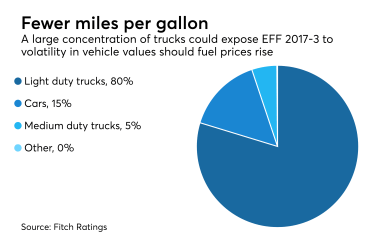
The increase reflects stronger demand from obligors as the performance of this industry improves, rather than a decision by the lessor, according to Fitch Ratings.
CarMax, BMW, Santander and Credit Acceptance Corp. all launched deals Thursday; they add to the $35 billion in prime auto, $12.31 billion in prime lease, and $19.4 billion in subprime auto loan ABS so far this year.

Over 80% of the cars are diesel-engine vehicles, bringing potential volatility to the portfolio cash flows given the public debate over potential panning such cars in several European urban centers.

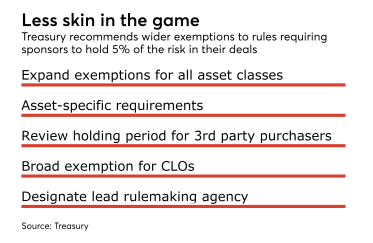
A report released Friday calls risk retention "an imprecise mechanism" for encouraging the alignment of interest between sponsors and investors. It recommends creating loan-specific requirements under which managers would receive relief.
The proportion of collateral that will be acquired after the CPS Auto Receivables Trust 2017-D closes is 33.3%, or $66 million, from the 29.7% level from the sponsor's prior deal in July.

The French specialty lender, owned by a consortium of mutual insurers, is pooling over 54,000 loans it originated and services for clients of its shareholders.

BMO is part of a trend-setting 2017 parade of Canadian auto lenders pooling their loan, lease and dealer floorplan receivables to the U.S. investor market.

Nissan's second U.S. lease-securitization of 2017 pools more than 71,000 contracts with $1.5 billion outstanding on cars, SUVs and cross-overs. Delinquencies remain low, but residual values are growing volatile.

Ford Motor Credit's second master trust issuance funding its dealer inventory financing has pushed floorplan ABS industry-wide past $8.5 billion, the busiest year for the asset class since 2014.

GM Financial is following similar actions by American Honda, Santander, Fifth Third and USAA to limit Texas exposure in securitizations, but the captive-finance lender has extended the exclusion to Florida loans as well.

Bank of Nova Scota's third overall deal in its brief auto-loan securitization history will feature $500m in U.S.-dollar denominated bonds.

The loans have an average balance of €18.5k (US$22.1k) and went to 39,698 borrowers; they are secured by a pool of new (46.8%) and used (53.2%) cars, according to Moody's Investors Service.

Credit enhancement for the senior, triple-A-rated notes is in line with recent Honda transactions, but the pool of collateral is concentrated (12%) in Texas and Florida, making it vulnerable to economic disruption from hurricanes.

HELOCs make up approximately 11.51% of the collateral; 22.5% of the HELOC borrowers are currently eligible to make draws up to their credit limit.

The San Francisco-based bank's first prime auto loan securitization in two years includes a sizable portion of loans (60% of the pool) with terms exceeding six years.
The €684.8 million transaction is backed primarily by new-car leases to German prime borrowers. It's the 21st German securitization by FCE Bank, Ford's UK-based captive finance arm.

The rental car giant is more dependent than ever on asset-backed financing after being downgraded in May, making high yield bond issuance prohibitively expensive.

The federal savings institution is pooling more than 33,000 well-seasoned auto loans to its armed services-linked membership base.
The credit quality of the collateral is lower, by several metrics, than that of Exeter's prior deal; however, S&P Global expects cumulative net losses to be in the same range, from 20.1%-21.1%.

Ford Motor Credit, GM Financial and Fifth Third Bancorp are marketing a combined $3.4 billion in prime auto loan and lease asset-backed securities, according to presale reports published Thursday.

Couldn’t load more articles. Try again.