
ABS Vegas: Waking the Sleeping Giant of Trade Finance
The rising costs for banks to hold even low-risk, short-term loans courtesy of Basel III is a powerful incentive for them to offload their trade finance receivables into securitizations.
The rising costs for banks to hold even low-risk, short-term loans courtesy of Basel III is a powerful incentive for them to offload their trade finance receivables into securitizations.
This week ASRs newscast covers Fitchs expectations of a slower improvement in mortgage-bond performance; a new far-reaching program from Santander & Citi for securitizing trade-finance assets; and TransUnions prediction of a continued rise in past-due payments on auto loans.

Chinas State Council introduced a series of measures that support the countrys developing securitization market but it wont be enough to significantly boost issuance in the short-term, said Fitch Ratings.
Upgrades might be in store for some Russian residential mortgage-backed securities (RMBS)
In late April, the Turkish Catastrophe Insurance Pool issued its first catastrophe bond; conditions would seem are ripe for other emerging markets to follow suit.
Despite the regulation-induced slowdown in Brazil, Fitch Ratings expects structured finance in Latin America to remain steady in both issuance and the credit environment.

Greater use of credit bureaus by Russian originators is a credit positive for securitizations in that country.
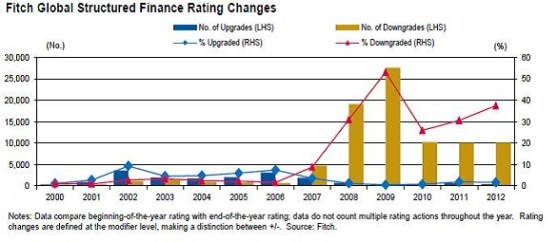
The catalysts were changes in the models used by Fitch, adverse selection in older mortgage pools, and the sovereign crisis in Europe.

Moody’s Investors Service has changed how it incorporates sovereign risk into structured finance transactions. The tweaked approach will inevitably result in some ratings downgrades. “The biggest impact will be in Europe, where the local currency ceilings have moved,” said Neal Shah, managing director at Moody’s. “And if we see material developments across the globe we’ll have to consider […]
After contracting sharply last year amid regulatory uncertainty and an economic slowdown, Brazil’s structured finance market now appears to be poised for a recovery.
Five new originators of Russian RMBS debuted last year; players say the issuer stable will keep growing.
Five new originators of Russian RMBS debuted last year; players say the issuer stable will keep growing.
After contracting sharply last year amid regulatory uncertainty and an economic slowdown, Brazil’s structured finance market now appears to be poised for a recovery.
Fitch Ratings took a swipe at its peers, saying some recent Mexican equipment lease securitizations they rated ‘AAA’ merit no more than a single ‘A’ rating.
Investors no longer feel limited to their own country for securitization investment opportunities; they are becoming comfortable with the risks and rewards of investing in and owning a global book.
Retail banks might return to the Mexican market or residential mortgage-backed securities.
In the EMEA area (Europe, Middle East, and Africa) a slew of commercial mortgage backed securities are maturing this month.
Couldn’t load more articles. Try again.