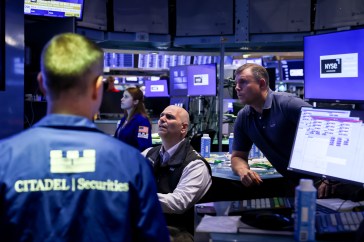
Citadel Securities’ Fed rate hike call adds to market angst
A hike would establish Warsh's inflation-fighting credibility, leading some, like Citadel Securities and PGIM, to assign a higher chance of an increase this week.
© 2026 Arizent. All rights reserved.

A hike would establish Warsh's inflation-fighting credibility, leading some, like Citadel Securities and PGIM, to assign a higher chance of an increase this week.
US 10-year yields fell for a third day, down three basis points to 4.62%, reducing their premium over two-year peers to the lowest in almost four weeks.

Given Barnard's stature, and since the new leadership structure is not yet in place, Titan Square Mile said it would remove the funds from its Academy of Funds.

Coming into 2026, State Street expected yields to fall toward 3.5% or lower this year, but instead they've been on the rise.

With Treasury yields out to the 10-year trading well above 4% and longer maturities sitting above 5%, investors are getting better compensated for holding bonds.

Unlike 2007, however, the Federal Reserve's benchmark is 150 basis points lower currently, suggesting investors are demanding even more compensation than at the start of the subprime debt woes.

Yields on Tuesday were higher by roughly two to four basis points across maturities, with the 10-year yield rising to touch its highest since late May at 4.64%.
Federal Reserve Bank of Dallas President Lorie Logan said at an event Thursday that conducting monetary policy actions through a third party would improve efficiency and make markets stronger.

Signs of "overheating" in the U.S. economy mean interest-rate hikes are more likely there than in Europe, dimming the appeal of Treasuries.

That short-term yield, which closely tracks expectations for the Federal Reserve's monetary policy, rose as much as five basis points to 4.23%.

The yield on two-year Treasuries, which is the most sensitive to changes in monetary policy, fell 6 basis points to 4.11%, while the 10-year yield declined 2 basis points to 4.46%.

From Capital Group to Insight Investment, Natixis and Pacific Investment Management Co., the message is the same: The sweet spot is the "belly," or the five-year area of the Treasury curve.

Falling oil prices also ease pressure on the Fed to raise interest rates to fight inflation. Swap contracts priced in slightly lower chances of more than one hike in the next year.

The moves on Monday pushed yields lower on most tenors, led by shorter maturities that are among the most sensitive to changes in monetary policy.

The New York Fed's open markets desk plans to conduct the reserve management purchases over the monthly period ending July 13 and conduct about $16.5 billion in reinvestment purchases over the same time.

Inflation accelerated again in May as the Iran war pushed up energy prices, outpacing wages for a second straight month. The consumer price index climbed 4.2% from a year earlier.

The catalysts for higher rates are strengthening even as President Donald Trump renews his calls for looser monetary policy on the eve of the first Fed policy meeting led by new Chairman Kevin Warsh.

Yields rebounded, trimming declines of two to three basis points across maturities, after the US Bureau of Labor Statistics' Job Openings and Labor Turnover Survey for April.

Beyond developments in the Middle East, a big focus will be Friday's release of monthly employment figures, which are projected to show the labor market remained resilient in May.

Through May 27, the Bloomberg Treasury Index gained 0.7% on the week, on course for its best weekly performance since Feb. 27, the day before the war started.

Couldn’t load more articles. Try again.