Avant returns after a stint to raise $450 million
Since July 21, 2021, the cutoff date before its last deal, Avant's active credit card accounts increased 388%, to its current 1 million accounts.

© 2026 Arizent. All rights reserved.

Since July 21, 2021, the cutoff date before its last deal, Avant's active credit card accounts increased 388%, to its current 1 million accounts.
The Swedish institution is adding savings accounts to its signature buy now/pay later service as it plots an IPO. Analysts say it will be a struggle to go against U.S. institutions.
The class A and class B notes benefit from credit enhancement levels of 12.50% and 8.75%, respectively, and the class A notes benefit from the subordination of class B certificates.

Investment banking fees shot up at the nation's largest bank, thanks to rebounds in M&A and the equity capital markets segment. And despite higher credit costs in the company's card business, a top bank executive expressed confidence in the health of U.S. consumers.
The deal benefits from excess spread, overcollateralization, and senior/subordinate enhancements.

Initially, the reserve account starts at 0.0%, but it will be funded to either 1.00%, 2.00% or 3.00%, depending on the level of the notes' three-month average excess spread.

A proposal from the Consumer Financial Protection Bureau to extend the same protections as credit cards to the fast-growing BNPL industry aims to protect consumers, but it could also stunt the nascent industry's growth, experts say.
A federal judge in Texas is locked in a back-and-forth with an appeals court over whether the industry's challenge to a cap on credit card late fees should be moved to Washington, D.C.

The number of borrowers who are at their credit limits is approaching its pre-pandemic level, and the percentage of balances that are sliding into delinquency has hit its highest rate in more than a decade, according to new research. Still, card companies are generally expressing optimism about their credit outlooks.
Price guidance was not available on the series 2024-1, the database notes that the series 2024-2 class A notes are expected to price between 63 and 65 basis points over the three-month interpolated yield curve.

Net charge-offs at the Charlotte, North Carolina-based bank increased by more than 80% in the first quarter compared with a year earlier. BofA executives say that the rising losses were in line with the bank's risk appetite.
The Federal Reserve scored some important legal victories in lawsuits challenging its discretion to grant or deny applicants for master accounts. But whether those victories will last through the appeals process or scrutiny from Congress is uncertain.
A federal appeals court is putting the transfer of a lawsuit challenging the Consumer Financial Protection Bureau on hold pending the outcome of a hearing on the suit's appropriate venue.
The top three industries includes software, healthcare and software development, accounting for 18.45%, 7.89% and 5.12%, respectively.

The weighted average (WA) credit line was $10,874, which Moody's said is low relative to other large card issuers, and in fact 69.5% of the pool has a credit limit of $10,000 or more.

Rising card balances—and delinquencies—might be a matter of normalization post-COVID, but securitization remains an attractive option for banks extending revolving credit, say observers.

Lenders collected an estimated $25 billion in additional interest income last year by raising the average margin on annual percentage rates, or the amount above the prime rate, according to the Consumer Financial Protection Bureau.
The blockbuster merger proposal will be reviewed at a time when the Biden administration is expressing skepticism about consolidation. Its analysis will have to account for markets dominated by both big banks and the likes of Visa and Mastercard.
The median interest rate that large credit card issuers charged consumers with good credit in the first half of 2023 was 28.2%, compared with 18.15% at smaller banks and credit unions, according to a study by the Consumer Financial Protection Bureau, which is on a campaign against excessive fees.
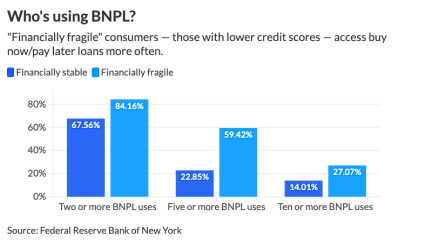
Financially stressed consumers nearing their credit limit use buy now/pay later loans to finance smaller purchases, while wealthier households want to avoid paying interest or carrying a balance on credit cards for bigger-ticket items, according to the New York Fed.
Couldn’t load more articles. Try again.