Watch spreads, not the Fed, for mortgage rate shifts
Concerns regarding AI companies' ability to handle inflation drove the 10-year Treasury under 5%, but with data still running hot, could yields turn upward?
© 2026 Arizent. All rights reserved.

Concerns regarding AI companies' ability to handle inflation drove the 10-year Treasury under 5%, but with data still running hot, could yields turn upward?
With how investors are reacting to inflation news and its impact on stocks, it would not take much to move markets in either direction when it comes to rates.
Fannie, Freddie and Ginnie loan eligibility now rests on AUS findings, with scores kept for pricing. KBW cut UWM's price target to $1.50 as it launches a $400M rights offering.
Zillow now predicts mortgage rates to end 2026 over 7%.
Given current rates are higher than the MBA and Fannie Mae forecasts, the industry could see further downside risk to the housing outlooks in October.

Last week's bond market turmoil continued leading up to the FOMC decision on Wednesday, pushing the 30-year fixed to near or over 7%, depending on the source.
For the first time in six weeks, the 30-year fixed rate mortgage dropped, with observers expecting a steady but challenging housing market for the rest of 2026.
Originators need to keep an eye on the 10-year Treasury yield used in pricing mortgages, which not only broke through 4.6%, climbed above 4.7% on Thursday.
Lenders are still frequent targets of the class action complaints over unwanted mortgage solicitations, violations that have netted litigants big paydays.
A week after falling to its lowest point since mid-May, the 30-year fixed rate mortgage turned higher as the 10-year Treasury rose 15 basis points since June.
A potential end to the Iran War could lead to economic recovery, suggesting sub-6% rates may be far off as monetary policy discussions take a hawkish tone.
For the fifth time in the past seven weeks, mortgage rates moved higher, Freddie Mac reported, as consumer prices keep rising due to the Iran conflict.
Market wonderment over inflation data and a possible halt to the Iran conflict resulted in what some trackers found to be a sideways week for mortgage rates.
The 30-year fixed spiked earlier in the week, but fell as Middle East news helped to drive the 10-year Treasury yield lower by 9 basis points by Wednesday.
The benchmark 10-year Treasury yield topped 4.4% on April 29 — its highest level since late March — as investor anxiety mounted.
The 30-year fixed is still over 20 basis points higher than its February bottom, but fell 7 basis points this past week on Iran peace hopes, Freddie Mac said.
For the second week in a row, the 30-year fixed increased by 11 basis points, Freddie Mac found, a result of reaction to oil price hikes from the Iran conflict.
The conflict pushed oil price futures above $100 a barrel for a short time earlier this week, which affected bond investors and the 10-year Treasury yield.
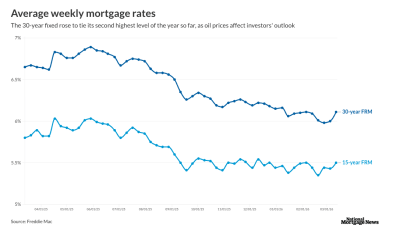
While this only shows a 2-basis-point rise in the 30-year fixed since last week, the Lender Price product and pricing engine data is 30 basis points higher.
For the first time since early September 2022, the Freddie Mac Primary Mortgage Market Survey has the 30-year below 6%, but the 15-year gained this week.
Couldn’t load more articles. Try again.