Watch spreads, not the Fed, for mortgage rate shifts
Concerns regarding AI companies' ability to handle inflation drove the 10-year Treasury under 5%, but with data still running hot, could yields turn upward?
© 2026 Arizent. All rights reserved.

Concerns regarding AI companies' ability to handle inflation drove the 10-year Treasury under 5%, but with data still running hot, could yields turn upward?
Incentives structure and fewer losses drive commercial real estate collateralized loan obligation issuance over conduit commercial mortgage-backed securities.

The home equity agreements provider faced a week of the 10-year Treasury almost breaking through 5.35%, and a period of peaking mortgage rates.

Investors drove long-term Treasury yields down this week on concerns regarding AI-related debt, but inflation and the Iran conflict can push rates higher.
Persistently high mortgage rates will shrink securitization volume by dampening home sales and pushing more buyers toward all-cash purchases.
With how investors are reacting to inflation news and its impact on stocks, it would not take much to move markets in either direction when it comes to rates.
Zillow now predicts mortgage rates to end 2026 over 7%.
Given current rates are higher than the MBA and Fannie Mae forecasts, the industry could see further downside risk to the housing outlooks in October.

Last week's bond market turmoil continued leading up to the FOMC decision on Wednesday, pushing the 30-year fixed to near or over 7%, depending on the source.
The market initially showed relief after the initial confirmation of an anticipated inflation-fighting hike but discussion of a future raise renewed concern.
Merging Fannie Mae and Freddie Mac may not be possible but there is a variation that maintains competition and adds efficiency, according to one shareholder.
If Fed Chair Kevin Warsh's comments lack substance on inflation in the market's opinion, it is likely to drive mortgage rates even higher, NerdWallet warned.
So far, annual home lending growth is on track to slow, but not stop, with some positive developments surfacing amid broader challenges.
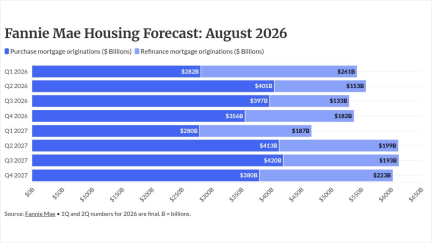
For the first time in six weeks, the 30-year fixed rate mortgage dropped, with observers expecting a steady but challenging housing market for the rest of 2026.
Despite the variety of loans in the pool, the vast majority of assets are considered qualified mortgages, with only 10.9% considered non-QM.

The 10-year Treasury yield rose to the highest level in more than 18 months last week after Fed Chair Kevin Warsh gave conflicting signals about the US central bank's plans to control inflation.

Fannie Mae and Freddie Mac are under directives to make mortgage-backed securities purchases that can exert downward pressure on rates or limit increases.
The property market has been held back in recent months by elevated borrowing costs, which had fallen below 6% in late February before the Middle East conflict boosted energy prices.

Originators need to keep an eye on the 10-year Treasury yield used in pricing mortgages, which not only broke through 4.6%, climbed above 4.7% on Thursday.
Economists at the government-sponsored enterprise have been lowering their single-family origination volume estimates for several months.
Couldn’t load more articles. Try again.