The outlook for hotels and suburban offices remains questionable, but the prognosis for other property types in the securitized commercial real estate market is fairly strong, according to Moody’s Investors Service.
Hotels dropped two points to a score of 51 in the second quarter, remaining in the yellow zone, which reflects Moody’s cautious outlook for the market. Suburban offices’ score of 62 also was in the yellow zone, but one point higher than the previous quarter.
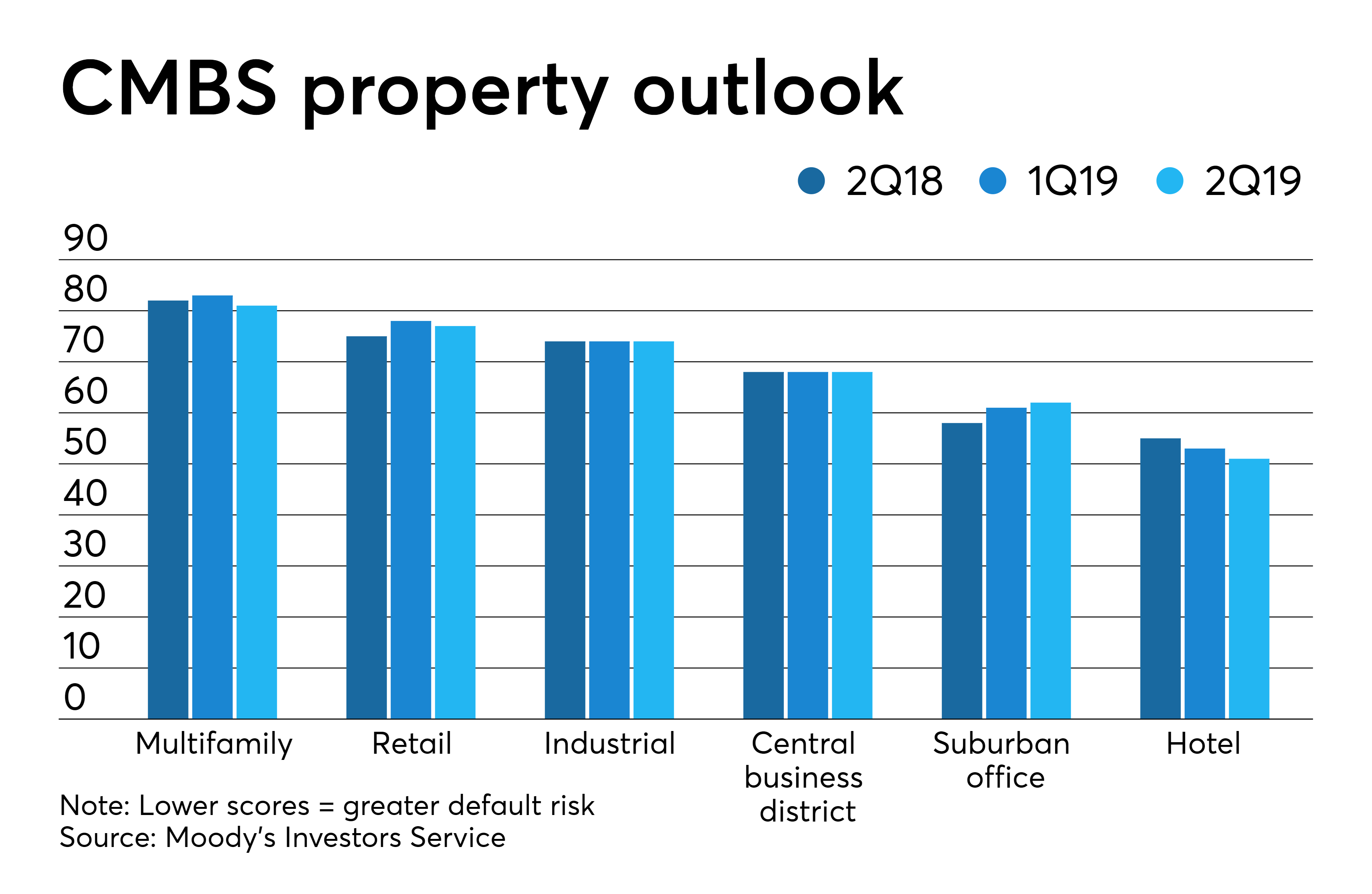
While other property sectors’ scores were in the green range in Moody’s stoplight-color-themed report, some of them did decline slightly.
“The composite score for the retail sector fell by one point, to green 77, during the second quarter,” Paul Cognetti, an analyst at Moody’s, said in a press release. “The sector’s vacancy rate was unchanged at 8.8% and upcoming supply growth stood at 0.6%, against 0.3% the prior quarter. Upcoming supply in the sector hasn’t exceeded 1% of existing inventory since the end of 2008.”
Multifamily’s score of 81 was two points lower than it was during the previous quarter, and the scores for central business districts and industrial properties remained constant at 68 and 74, respectively.
Compared to a year ago, many property sectors’ scores are similar, but hotels have a slightly lower score and the score for suburban offices is higher.
Regionally, scores improved in Boston, Chicago and Philadelphia, but scores in Austin, Detroit and New Orleans dropped.
Moody’s scores are designed to reflect the extent to which markets might experience a near-term drop in rent or occupancy rates. Declines in these areas are considered key indicators of default risk in the commercial mortgage-backed securities market.