EU officials propose guardrails for insurance SRT boom
Insurers' unfunded significant risk transfers should meet a set of extra solvency criteria to ensure stability if policymakers back the most lenient bank-capital treatment.

© 2026 Arizent. All rights reserved.

Insurers' unfunded significant risk transfers should meet a set of extra solvency criteria to ensure stability if policymakers back the most lenient bank-capital treatment.
The chief risk officer's oversight extends to the modernization of loan pricing and scoring, which the GSEs' oversight agency has been accelerating.

Heading into this week's Federal Open Market Committee meeting, the Fed's core indicators are painting a different picture of the economy than real-time measures, injecting more uncertainty into Wednesday's FOMC meeting than usual.

The Supreme Court may have allowed the central bank to chart its own course on bank oversight for now, but discrepancies between two recent rulings set the stage for challenges.

The central bank failed to prevent critical economic information from falling into the hands of "foreign adversaries," according to a report from its inspector general.

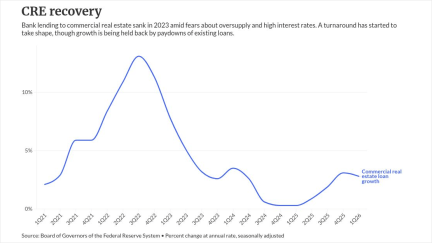
Lenders pulled back on commercial real estate loans in 2023, as high interest rates put pressure on property values. They're now returning to the sector, and the renewed competition is prompting a pricing war.
The International Finance Corporation, has agreed to insure the credit risk on a $500 million portfolio of trade finance tied predominantly to low-income and conflict-affected countries.

Three senior officials say attackers will eventually breach bank defenses, and supervisors should plan for it — while U.S. regulators stay nearly silent.

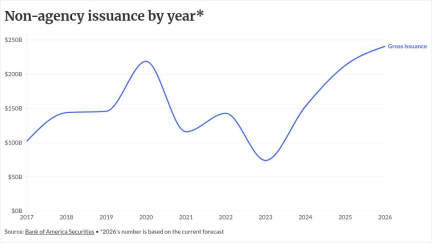
Large loan balances are increasingly common in non-QM and HELOC securitizations, bringing faster prepayments and higher delinquency risks, Bank of America Securities research shows.
Use of the instruments … is growing, and was equivalent to around 2% or less of total bank loans in the European Union, US, the UK and Canada at end-2024.

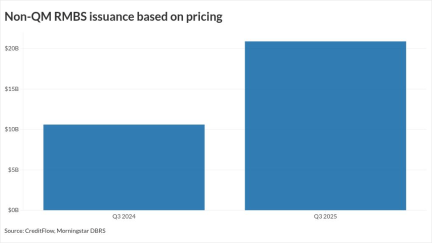
New private-label bonds collateralized by loans made outside the qualified mortgage definition hit highs for the month, quarter and year, CreditFlow data shows.
Fannie Mae and Freddie Mac's credit risk-transfers and some older private-label mortgage-backed securities have exposures to the Washington DC area.

The tests modeled how Fannie Mae and Freddie Mac would fare after absorbing losses like a total $36.1 billion provision in credit losses in a severe downturn.

Loans with alternative documentation and high combined loan-to-value ratios had more performance concerns, according to a new KBRA study.
As the risk of a recession rises, commercial real estate loans remain a major concern for banks and industry participants. One observer asked: "Is '25 the year where sellers start to capitulate, call a loser a loser, and move on?"

Only 5% of homeowners in designated disaster-assistance areas were required to hold flood insurance, according to the Federal Housing Finance Agency's dashboard.

The Federal Deposit Insurance Corp. and Texas banking regulators issued consent orders against Industry State Bank, Fayetteville Bank and Citizens State Bank, requiring major overhauls of their management, capital and risk controls.

Awareness of disaster risk has increased in the public and private sectors, and it appears to be prompting more interest in home improvements in particular.

As the commercial real estate industry sputters along, lenders, investors and analysts are putting less stock in loan-to-value ratios, a longtime bellwether of risk.
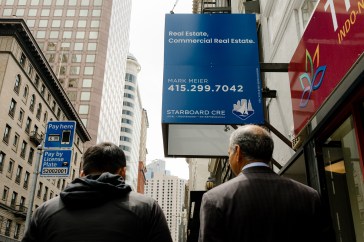
The regional bank has already seen a large reduction in "criticized" loans, and it expects that trend to pick up as lower borrowing costs alleviate the pain in the commercial real estate sector.

Couldn’t load more articles. Try again.