What’s behind rising delinquencies on private-label credit cards
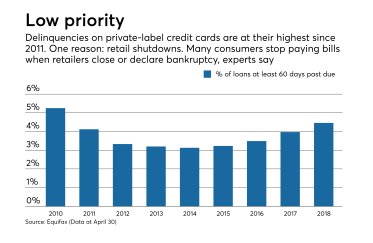
It’s not just weaker underwriting and higher household debt levels that are driving past-due rates to their highest levels in seven years.
By
Andy Peters
© 2026 Arizent. All rights reserved.

It’s not just weaker underwriting and higher household debt levels that are driving past-due rates to their highest levels in seven years.
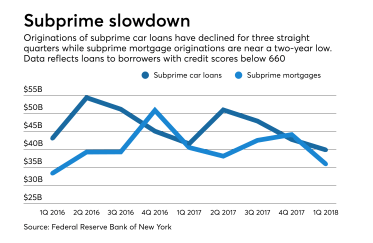
The post-recession boom in auto loans and credit cards for borrowers with marred credit histories has been winding down in recent months.
The Dallas-based lender, a unit of the global banking giant Banco Santander, was able to lower credit enhancement on the senior notes to 63.55% from 65.25% on the previous deal in February.

AmeriCredit returns to securitization for the first time since November with a $1.1 billion deal, while Flagship's $223 million deal, its second of 2018, takes a step back in collateral quality.

The senior tranche of Credit Acceptance Auto Loan Trust 2018-2 benefits from initial credit enhancement of 51.61%, up from 49.93% in a February deal; it comes from additional subordination.

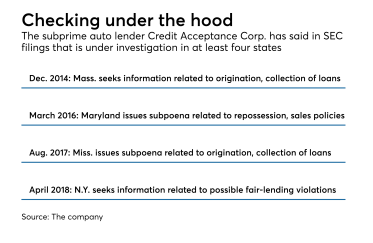
Auto lenders would be well advised to keep up their guard as states — particularly blue ones — take steps of their own to crack down on what they see as abusive practices.
While DBRS maintained a rating of AA for the Lendmark Financial's first ABS of 2018, S&P issued an A rating after estimating higher net losses on the underlying subprime accounts.

RAC King (d/b/a American Car Center) has expanded rapidly since being acquired in a 2016 leveraged buyout; now it's bundling most of its portfolio into collateral for bonds.

The $185 million transaction features a higher exposure to borrowers entering bankruptcy than the sponsor's 2016 deal; it's also more seasoned, since it recycles 2014 collateral.

Higher LTVs and fewer low-risk, new-car loans trumped the recent decline in managed-portfolio delinquencies and improved ABS performance since 2015.

The subprime auto lender failed to disclose that it received fees for referring borrowers to CarMax, the used-car dealer, according to California's financial regulator.
But GMF's deeper dive into long-term loans for a pool increasingly dominated by pricier trucks and SUVs caused a slight bump in expected ABS credit losses.

The performance of outstanding transactions issued via the Capital Auto Receivables Trust platform is weakening, so rating agencies are demanding additional investor protections.

Credit enhancement on the senior notes has risen to 36.25% from 28.7% to account for higher expected losses on the collateral; Kroll's base-case range is for 6.75% to 8.75% over the life of the deal.

DriveTime's improving loss performance in recent securitizations allowed it to relax the enhancement levels on its first securitization of the year.

Despite riskier terms, rising delinquencies and falling used car values, investors keep buying bonds backed by prime and subprime auto loans and leases.

The three offerings push the first-quarter volume of subprime auto loan asset-backeds past $5 billion, an indication of unwavering demand for the risky asset class.

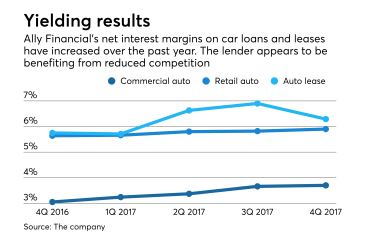
The Detroit company recorded an 11% increase in car loans and leases originated during the fourth quarter, as well as a jump in yields. Ally appears to be benefiting from Wells Fargo's substantial retrenchment in auto lending.
The credit quality of the collateral appears to have improved, but investor protections have also decreased; as a result, Kroll is only assigning an 'A' to the senior tranche of notes.

The Salt Lake City-based lender homes in on troubled borrowers whose subprime status is primarily tied to a recent bankruptcy protection filing.

Couldn’t load more articles. Try again.