Credit risk transfers earn bipartisan praise
Credit risk transfers, a means by which banks can move risk off their balance sheets, earned considerable bipartisan support in a House Financial Services subcommittee hearing Wednesday.

© 2026 Arizent. All rights reserved.

Credit risk transfers, a means by which banks can move risk off their balance sheets, earned considerable bipartisan support in a House Financial Services subcommittee hearing Wednesday.
As the inflation reduction campaign has miles to go, banks considering credit risk transfers referencing commercial real estate could find enthusiastic investors.

The real estate investment trust arm of two affiliate mortgage-related companies could reduce other debt and finance purchases of loans, servicing or securities.

The government-sponsored enterprises will likely have their mainstay bonds exempted from the potential securitization-related rule, but their credit-risk transfers could be subject to it, some experts say.

The two latest transactions follow in the wake of the government-sponsored enterprise’s first deal of the year and the release of a finalized capital rule aimed at facilitating broader risk-sharing.

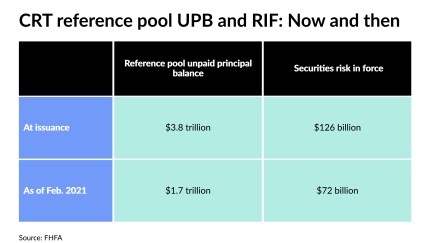
Issuance of capital market instruments aimed at protecting one government-sponsored enterprise from distressed mortgage credit events staged a relatively quick rebound in 2020, a new Federal Housing Finance Agency report shows.
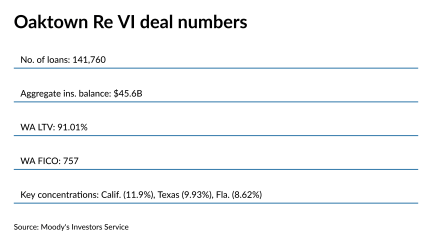
Oaktree Re VI 2021-1 will market $531 million in CRT notes that will provide NMI with partial reinsurance on a $45B pool of GSE-eligible loans.
The $16.9 billion in issuance marked the biggest annual number seen since the government-sponsored enterprise reconstituted its risk sharing program in 2013.
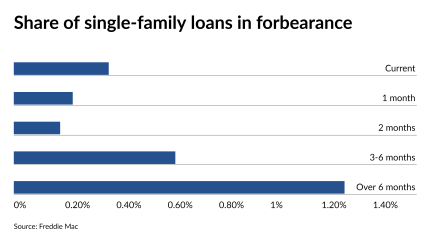
The reference pools of mortgages supporting the credit-risk transfer notes sold by Fannie Mae and Freddie Mac were 'generally lower' in delinquencies per newly issued monthly reports, says DBRS Morningstar.

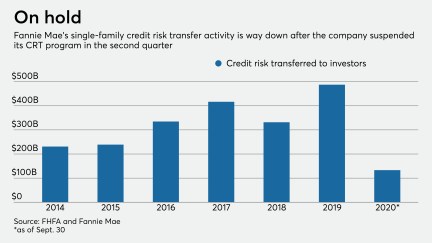
Fannie hasn't completed any credit risk transfers to private investors since the second quarter. Some experts worry the decision — likely spurred by the company’s concerns about a recent capital regulation — could put the mortgage giant on unsteady footing.
While using the 30-day SOFR as its index, Freddie Mac structured the deal so it could shift to a one-month term if and when that rate is approved.
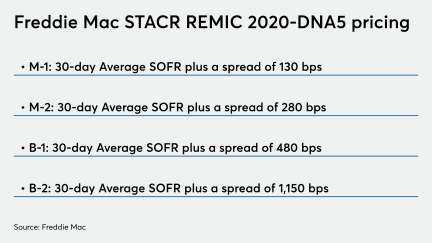
Following its deadline for written comments on the topic last month, the Federal Housing Finance Agency is scheduling events that will focus on two key themes emerging in responses.

Arch's second CRT transaction this year to obtain indemnity reinsurance for mortgage-insurance premiums comes at a time it is also experiencing rising 60-plus-day delinquencies on its outstanding securitized pools.

There were questions about the GSEs' use of structured credit risk transfers in the single-family market given an earlier pandemic-related market disruption.
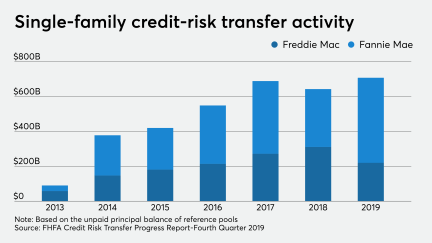
A bond market once thought to be key to the futures of Fannie Mae and Freddie Mac — and the roughly $5 trillion of home loans they backstop — could instead find itself on the scrap heap due to their own regulator.

The FHFA looks to shed light on the amount of funds Fannie and Freddie will need to hold for their risk-sharing deals.
While Freddie Mac stabilized liquidity in mortgage markets, coronavirus-related credit losses drove the GSE's income down in the first quarter of 2020.
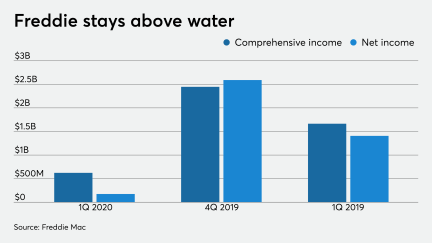
Freddie Mac saw a decline in net profit in 2019 due to decreased interest rate income, lower amortization revenue and risk-reducing investment costs, but its consecutive-quarter results improved.
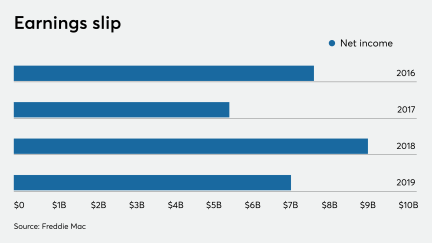
Eagle Re 2020-1 is backed by the performance of a reference pool of 156,065 loans with an outstanding balance of $40 billion.
Fannie Mae is sponsoring a $1.03B CRT transaction, while Caliber Homes Loans, New Residential and Onslow Bay fill the non-QM pipeline

Couldn’t load more articles. Try again.