Mortgage debt climbed to a new peak of $9.4 trillion in 2019’s second quarter, surpassing the height of $9.3 trillion when housing crashed in 2008, according to the Federal Reserve Bank of New York.
That towering figure breaks down to an average of $33,680 held per capita — inclusive of those with and without home loans — nationwide, according to financial data provider HowMuch. Totals varied from state to state and property owners in the most expensive parts of the country — the Northeast and West Coast — have the highest balances.
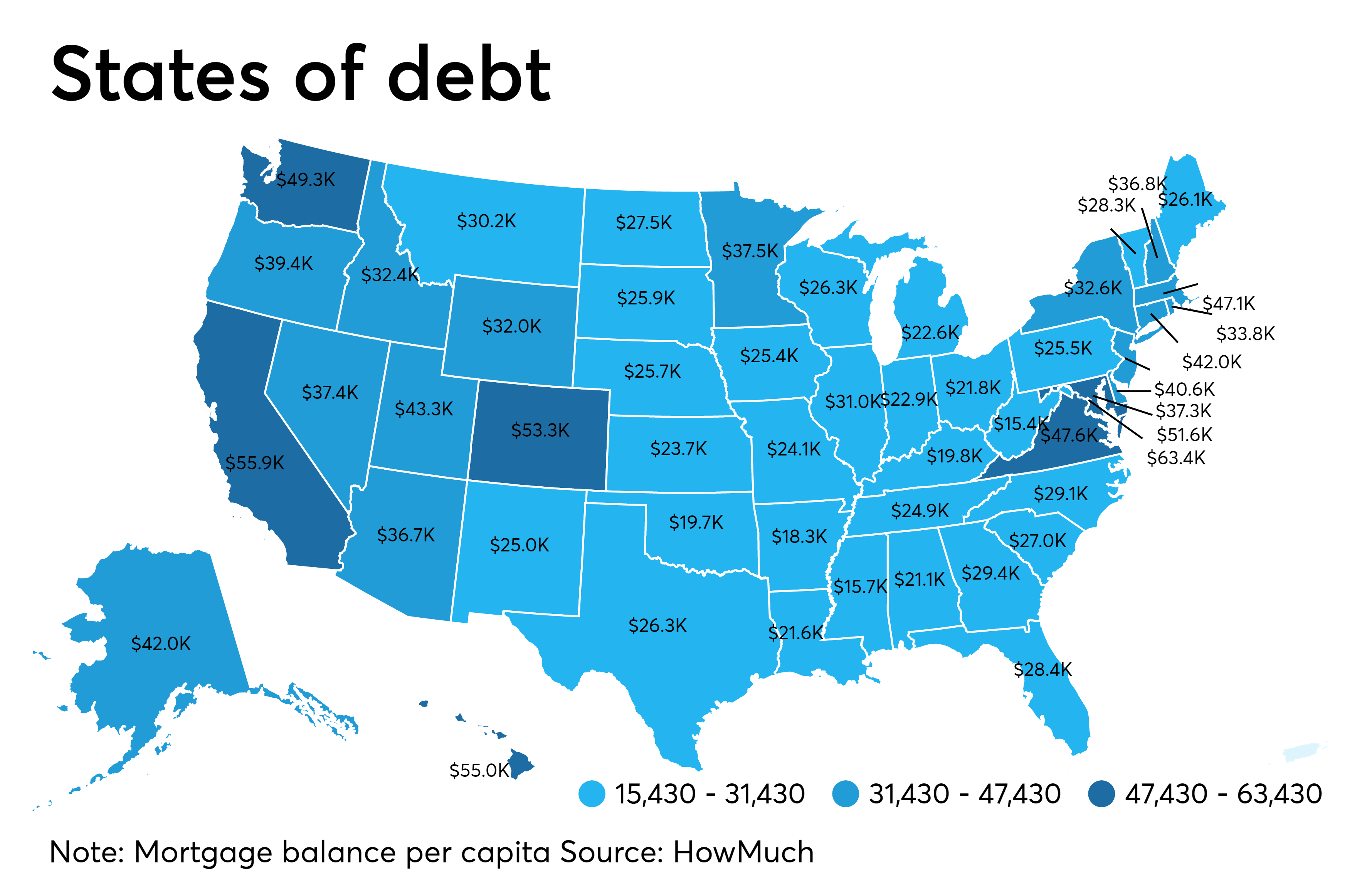
Nationwide, Washington, D.C., had the highest outstanding debt balance with $63,430 per capita. California followed with $55,920 and Hawaii was third with $54,980. Colorado and Maryland joined as the only other states over the $50,000 balance level.
At the end of 2008, nine states eclipsed $50,000 in per capita debt, with California’s $70,100 leading the way followed by Washington, D.C.’s $59,810 and Nevada’s $57,910.
On the opposite end of the spectrum, West Virginia had the lowest per capita mortgage debt at $15,430. Mississippi and Arkansas rounded out the bottom three with $15,710 and $18,260, respectively. Kentucky and Oklahoma were the only other states that fell below the $20,000 mark.
In the year of the housing crisis, West Virginia also had the lowest balance by population with $14,870. Mississippi again came next with $15,500, followed by North Dakota with $17,920.
In a similar study based only on those with mortgages, Generation Xers were shown to carry the most debt of any age group with an average of $237,753 as of the first quarter of 2019, according to Experian. However, with a growing amount of millennials settling down and becoming first-time homebuyers, they’re projected to take the lead soon. The demographic holds an average of $222,211 in debt, a 5% rise year-over-year — the second-highest annual growth next to Generation Z’s 15% jump.